> For the complete documentation index, see [llms.txt](https://cs61b-2.gitbook.io/cs61b-textbook-2025/llms.txt). Markdown versions of documentation pages are available by appending `.md` to page URLs; this page is available as [Markdown](https://cs61b-2.gitbook.io/cs61b-textbook-2025/38.-compression-and-complexity/38.2-prefix-free-codes.md).
# 38.2 Prefix-free Codes
Consider the representation of English text in Java. We represent text as a sequence of characters, each taking 8 bits of memory.
One easy way to compress, then, is to simply use less than 8 bits per character. To do this, we have to decide which **codewords** (bit sequences) go with each **symbol** (character).
## Mapping Alphanumeric Symbols
### Morse Code
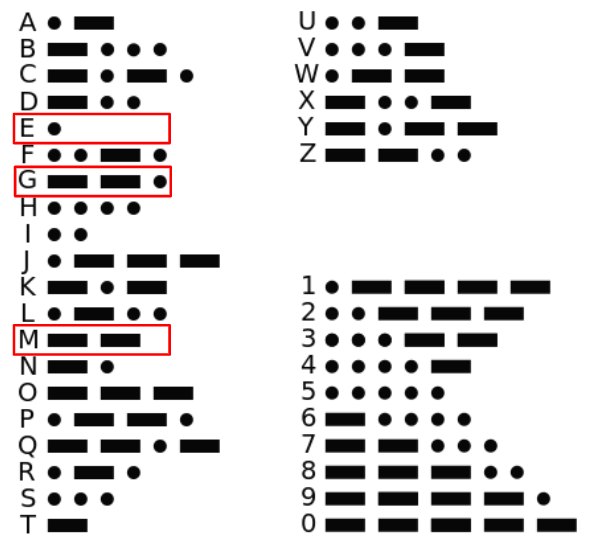
As an introductory example, consider the Morse code alphabet. Looking at the alphabet below, what does the sequence – – • – – • represent? It’s ambiguous! The same sequence of symbols can represent either MEME, or GG, depending on what you choose – – • to represent
Ambiguity in morse code
In real usage, operators must pause between codewords to indicate a break. The pause acts as an implicit third symbol, but we can't encode this real-time information into our code.
### Prefix-free Codes
An alternate strategy to avoid the need for real-time is to use **prefix-free codes**. In a prefix-free code, no codeword is a prefix of any other. In the Morse Code example, there would be no confusion whether the – – in the pattern – – • – – • is supposed to represent M, or the start of G.
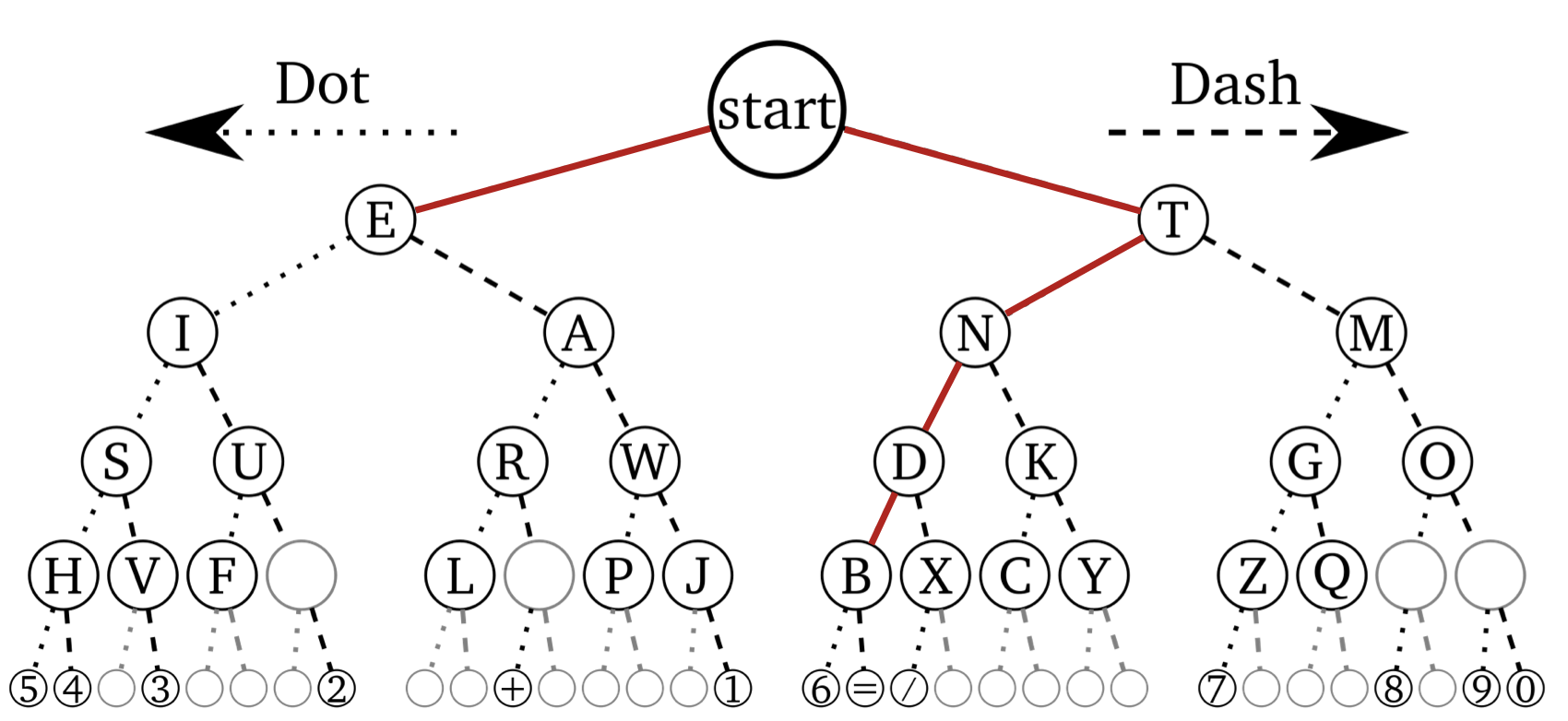
Let's represent Morse code as a tree of codewords leading to symbols. As we can see from the tree, several symbols have representations that are prefixes of other symbols.
Morse code is not prefix-free.
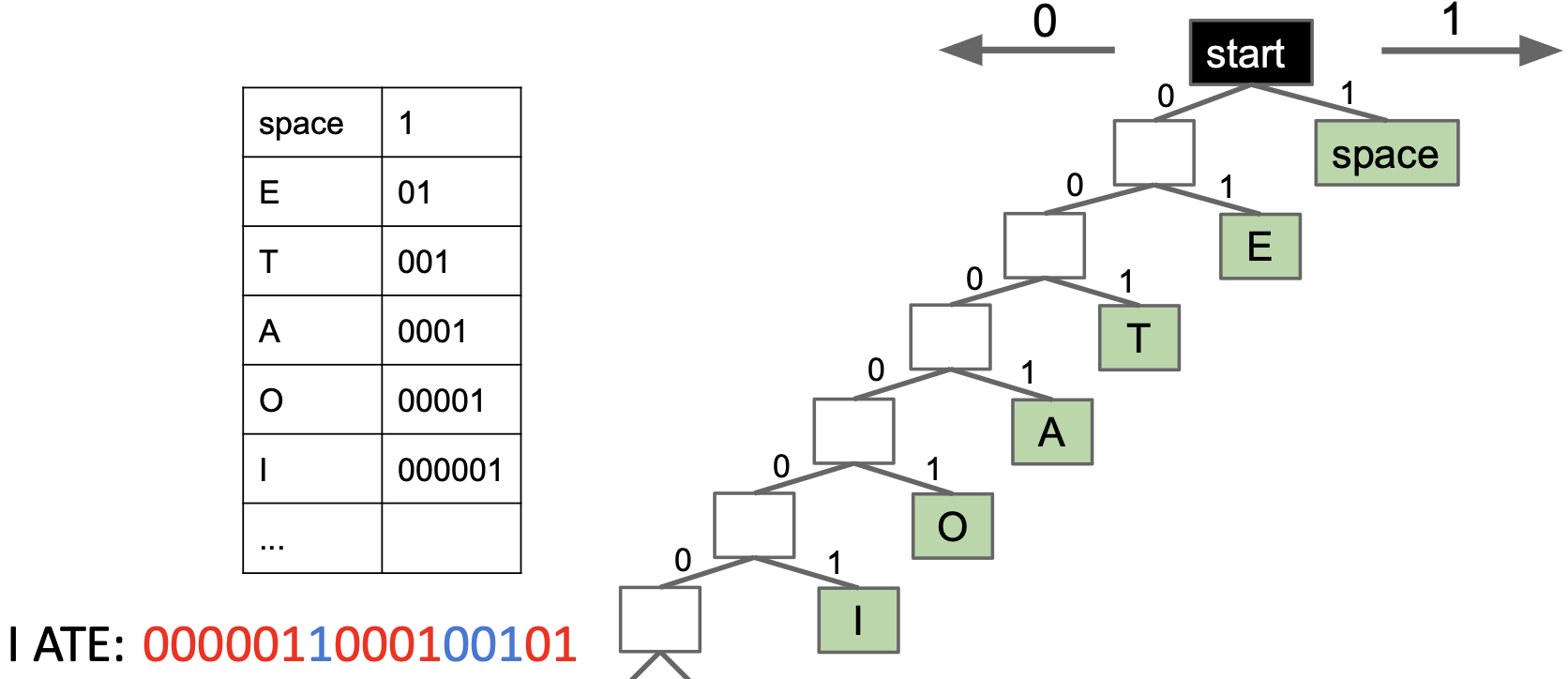
As an example of an (arbitrary) prefix-free code, consider the following encoding:
One prefix-free code.
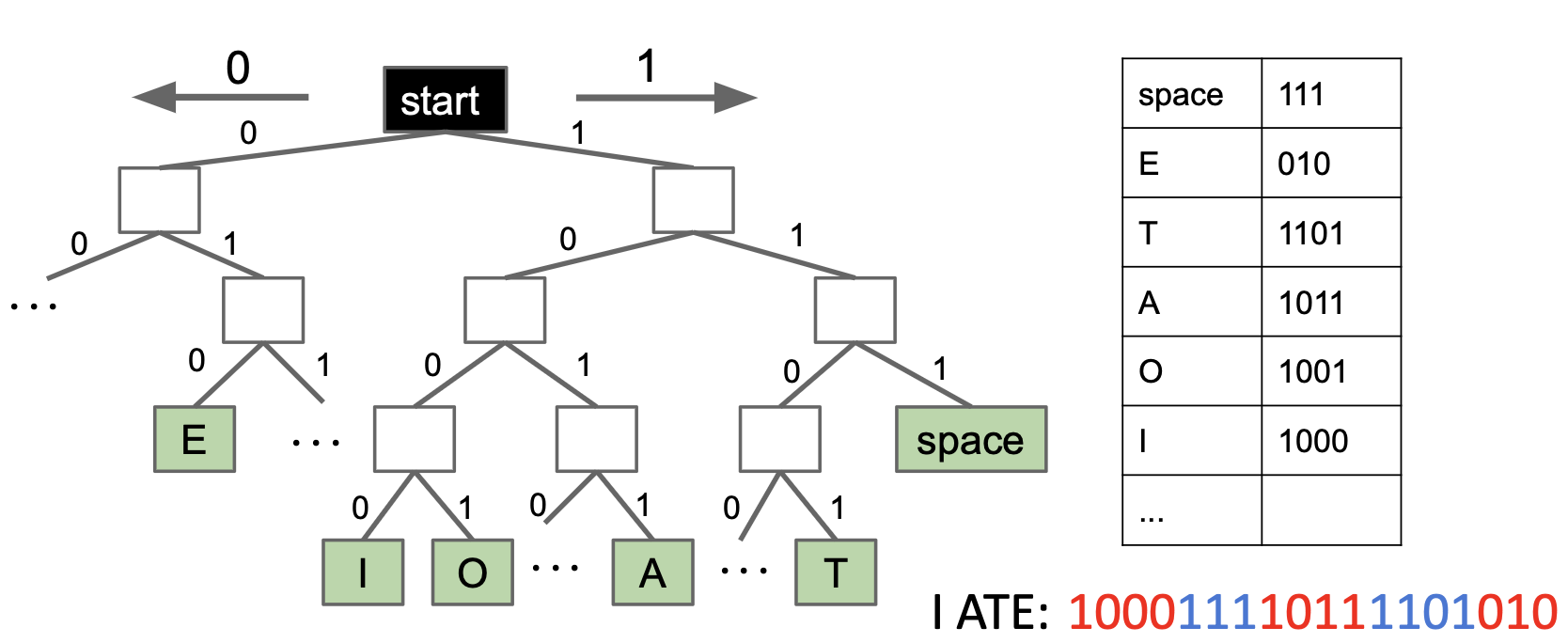
The following code is also prefix-free:
Another prefix-free code.
Note that some codes are more efficient for certain strings than others: in the first representation, `I ATE` uses less bits than the second code. However, this is highly dependent on what string we're trying to encode.