> For the complete documentation index, see [llms.txt](https://cs61b-2.gitbook.io/cs61b-textbook-spring-2026/llms.txt). Markdown versions of documentation pages are available by appending `.md` to page URLs; this page is available as [Markdown](https://cs61b-2.gitbook.io/cs61b-textbook-spring-2026/8.-inheritance-i-interface-and-implementation-inheritance/8.6-abstract-data-types.md).
# 8.6 Abstract Data Types
An Abstract Data Type (ADT) is defined only by its operations, not by its implementation.
For example in Project 1A, we developed an `ArrayDeque` and a `LinkedListDeque` that had the same methods, but how those methods were written was very different. In this case, we say that `ArrayDeque` and `LinkedListDeque` are *implementations* of the `Deque` ADT.
From this description, we see that ADT's and interfaces are somewhat related. Conceptually, `Deque` is an interface for which `ArrayDeque` and `LinkedListDeque` are its implementations. In code, in order to express this relationship, we have the `ArrayDeque` and `LinkedListDeque` classes inherit from the `Deque` interface.
Some commonly used ADT's are:
* Stacks: Structures that support last-in first-out retrieval of elements
* `push(int x)`: puts x on the top of the stack
* `int pop()`: takes the element on the top of the stack
* **Lists**: an ordered set of elements
* `add(int i)`: adds an element
* `int get(int i)`: gets element at index i
* **Sets**: an unordered set of unique elements (no repeats)
* `add(int i)`: adds an element
* `contains(int i)`: returns a boolean for whether or not the set contains the value
* **Maps**: set of key/value pairs
* `put(K key, V value)`: puts a key value pair into the map
* `V get(K key)`: gets the value corresponding to the key
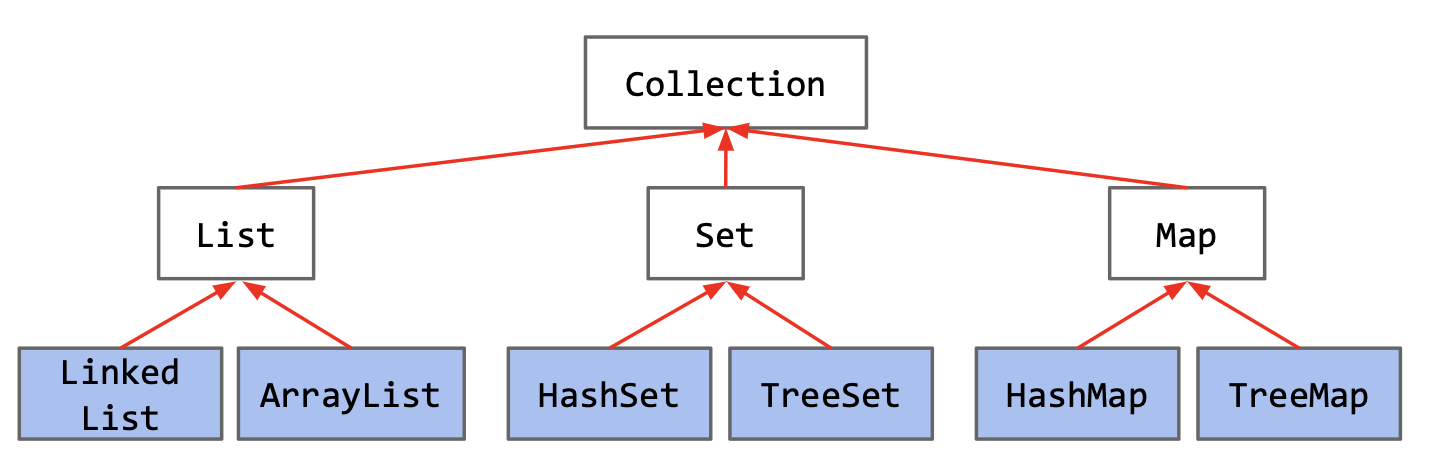
Note: the bolded ADT's are a subinterfaces of a bigger overarching interface called `Collections.`
Below we show the relationships between the interfaces and classes. Interfaces are in white, classes are in blue.
Common interfaces in Java and their implementations
ADT's allow us to make use of object oriented programming in an efficient and elegant way. For example, you saw in Project 1C how you can use an ArrayDeque or a LinkedListArrayDeque interchangeably because they are both part of the Deque ADT.
In the following chapters, we will work on defining some more ADT's and enumerating their different implementations.
{% embed url="" %}
---
# Agent Instructions
This documentation is published with GitBook. GitBook is the documentation platform designed so that both humans and AI agents can read, navigate, and reason over technical content effectively. Learn more at gitbook.com.
## Querying This Documentation
If you need additional information that is not directly available in this page, you can query the documentation by asking a question.
Perform an HTTP GET request on the following URL with the `ask` and `goal` query parameters:
```
GET https://cs61b-2.gitbook.io/cs61b-textbook-spring-2026/8.-inheritance-i-interface-and-implementation-inheritance/8.6-abstract-data-types.md?ask=&goal=
```
`ask` is the immediate question: it should be specific, self-contained, and written in natural language.
`goal` is what the user is ultimately trying to achieve, the reason they need the answer. Sharing it helps GitBook give you a better, more relevant answer. A goal is most helpful when it describes the outcome the user wants rather than restating the question. For example, with `ask=how do I create an API token`, a goal like `automate deployments from our CI pipeline` lets GitBook tailor the answer to that use case.
The response will contain a direct answer to the question and relevant excerpts and sources from the documentation.
Use this mechanism when the answer is not explicitly present in the current page, you need clarification or additional context, or you want to retrieve related documentation sections.